Research reviewed: September 1, 2026. Product capacities and electricity use vary by model and test conditions; always confirm the manufacturer’s specifications before buying.
Humidity is not a minor issue in the Philippines. PAGASA describes the country’s climate as tropical and maritime, with average monthly outdoor relative humidity ranging from about 71% in March to 85% in September. Indoor conditions depend on ventilation, air-conditioning, leaks, room temperature and daily activities, but the climate explains why musty closets, window condensation and slow-drying laundry are familiar problems in many homes.
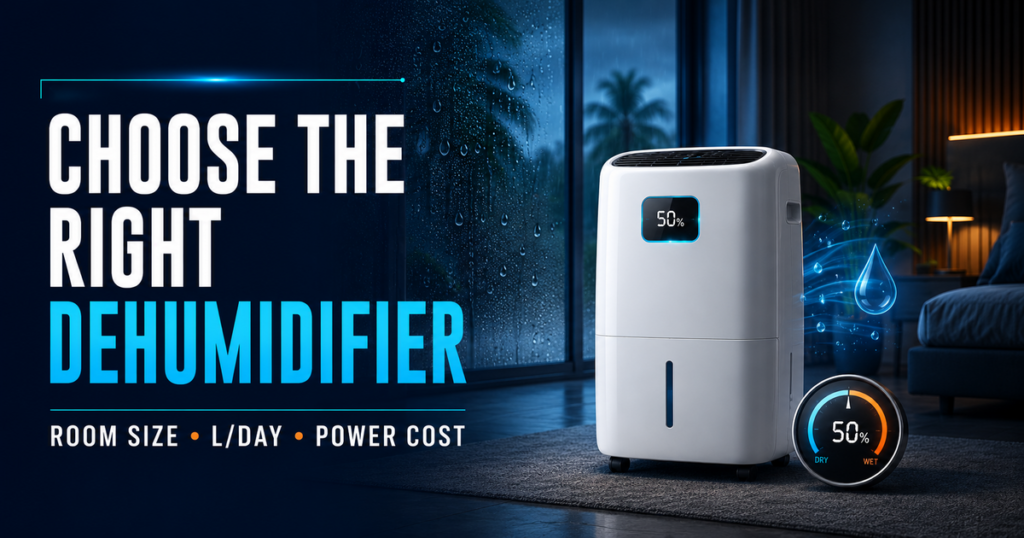
A dehumidifier can help when excess moisture is genuinely the problem. Choosing one well requires more than comparing prices or selecting the largest “square-meter coverage” printed on a listing. You need to know the room’s humidity, the appliance’s water-removal capacity, its power consumption, and how the collected water will be drained.
The quick answer
- Measure the room with a separate hygrometer before buying.
- A practical initial target is around 50%–55% relative humidity, while keeping the room below 60%.
- For most warm Philippine rooms, a compressor dehumidifier is the sensible default.
- Compare capacity in liters per day, not tank size.
- Choose more capacity for indoor laundry, persistent condensation, open layouts or frequent door opening.
- Check rated watts, continuous drainage, noise, auto restart, warranty and local service support.
- Fix leaks and remove existing mold; a dehumidifier does not repair the moisture source.
Do you actually need a dehumidifier?
Start with evidence rather than discomfort alone. Warm air can feel sticky even when a particular room does not require a dedicated appliance. Buy an inexpensive digital hygrometer and record relative humidity at different times for several days, especially early morning, after rain, after bathing and while drying clothes.
Common signs of a moisture problem include:
- readings that repeatedly remain above 60%;
- a persistent musty odor;
- condensation on windows, pipes or walls;
- clothes or towels that take unusually long to dry indoors;
- damp-feeling bedding, paper, leather goods or cabinet interiors; and
- recurring surface mold after proper cleaning.
The U.S. Environmental Protection Agency recommends keeping indoor relative humidity below 60%, ideally between 30% and 50%. The U.S. Centers for Disease Control and Prevention advises keeping it no higher than 50% when possible. In a warm, humid Philippine home, setting a machine around 50%–55% can be a practical starting point; monitor the room and adjust rather than forcing the lowest available setting.
When a dehumidifier is not the first solution
If water is entering through a roof, wall, pipe, window or floor, repair that problem first. Improve bathroom and kitchen exhaust, vent moisture-producing appliances, and avoid drying laundry indoors when outdoor conditions allow. A dehumidifier can manage residual airborne moisture, but it should not be used to conceal an active leak or untreated water damage.
Visible mold also requires cleaning and moisture-source correction. A dehumidifier may help prevent recurrence, but it does not remove established mold from building materials or furnishings.
Compressor, desiccant or thermoelectric?
| Type | Best use | Important limitation |
|---|---|---|
| Compressor or refrigerant | Bedrooms, living rooms, laundry areas and other warm spaces | Heavier and usually louder; performance declines in unusually cool rooms |
| Desiccant | Cool locations or applications requiring strong low-temperature moisture removal | Often consumes more electricity and releases warmer air |
| Thermoelectric or Peltier | Very small enclosed spaces, cabinets or light localized moisture | Removal may be measured in hundreds of milliliters rather than liters per day; usually inadequate for a damp bedroom |
For most occupied rooms in the Philippines, a compressor model offers the most useful balance of extraction capacity and energy consumption. Small thermoelectric units can be quiet and inexpensive, but buyers should compare their stated milliliters per day with the liters per day offered by a room-sized compressor unit.
Understand liters per day
A dehumidifier’s capacity is the amount of water it can remove from the air over 24 hours under specified laboratory conditions. A “20L/day” model does not have a 20-liter tank, and it will not necessarily collect 20 liters in your room every day. Actual removal changes with temperature, starting humidity, airflow, room leakage and the manufacturer’s test method.
The water tank may hold only two to five liters even when the advertised extraction capacity is much higher. Tank capacity tells you how often it may need emptying; extraction capacity tells you how much moisture the machine is designed to remove.
EverReach practical starting points
| Space and condition | Capacity to shortlist |
|---|---|
| Cabinet, wardrobe or extremely small enclosure with light moisture | Moisture absorber or small thermoelectric unit; compare mL/day carefully |
| Small closed room, roughly 10–20m², with moderate humidity | About 10–16L/day |
| Bedroom or multipurpose room, roughly 20–35m², or regular indoor laundry | About 16–25L/day |
| Larger room, open-plan space or consistently heavy moisture load | About 25–35L/day or more |
| Active seepage, flooding or severe recurring mold | Fix the water source and seek qualified assessment; appliance capacity alone is not the solution |
Floor area is only the beginning. Select additional capacity if the room has high ceilings, frequently opened doors, poor sealing, a connected bathroom, indoor clothes drying or humidity that remains above 75%. An adequately sized unit can reach the target sooner and cycle off; an undersized unit may run continuously without gaining control.
ENERGY STAR’s published guidance similarly sizes units using both space and dampness. For spaces below 2,000 square feet, its minimum ranges rise from 20–30 pints per day for moderately damp conditions to 30–50 pints for wet conditions—approximately 9.5–14.2L/day and 14.2–23.7L/day respectively.
Estimate the electricity cost
Do not judge electricity use by liters per day alone. Find the unit’s rated input power in watts, then use your household’s actual peso-per-kilowatt-hour rate from the electric bill.
Monthly kWh = watts ÷ 1,000 × hours used per day × days per month
Estimated monthly cost = monthly kWh × your electricity rate
Example: a 280W dehumidifier running eight hours daily for 30 days would use a maximum of approximately 67.2kWh:
0.280kW × 8 hours × 30 days = 67.2kWh
At an example rate of ₱12 per kWh, that would be about ₱806 for the month. Substitute the rate on your own bill. Actual consumption may be lower when the built-in humidistat cycles the compressor off after reaching the target, but a persistently damp or open room may keep it running much longer.
When comparable efficiency data is available, look for Integrated Energy Factor in liters per kilowatt-hour. A higher L/kWh value means the appliance removes more water for each unit of electricity.
Features worth paying for
- Adjustable humidistat: lets the unit maintain a target instead of running indefinitely.
- Clear humidity display: useful for monitoring, although a separate hygrometer provides an independent check.
- Continuous drain connection: valuable during rainy periods or for indoor laundry. Confirm whether it uses gravity or includes a pump.
- Full-tank shutoff: prevents overflow when using the bucket.
- Auto restart: useful after brief power interruptions, but confirm whether the previous humidity setting is restored.
- Washable pre-filter: helps protect the coils and fan from household dust.
- Defrost protection: important if the appliance may operate in an unusually cool air-conditioned room.
- Acceptable noise: compare published decibels for nighttime bedroom use and check whether the low mode reduces both fan speed and extraction.
- Local warranty and service: verify compressor coverage, parts availability and the location of an authorized service center.
- Correct electrical rating: buy a model intended for Philippine 220–240V, 60Hz power rather than an imported 110V appliance.
Placement and operation
- Close the room’s doors and windows while the dehumidifier is running.
- Leave the clearance specified by the manufacturer around air intake and exhaust openings.
- Place the unit on a firm, level surface and use a properly grounded outlet.
- Route a drain hose continuously downhill unless the unit has a condensate pump. Avoid electrical connections and tripping hazards.
- Clean the filter at the recommended interval. A clogged filter reduces airflow and efficiency.
- Expect the air leaving a compressor dehumidifier to feel slightly warmer. The machine removes moisture but does not cool the room like an air conditioner.
- After moving or tilting a compressor unit, follow the manufacturer’s waiting period before switching it on.
Dehumidifier vs air conditioner vs air purifier
An air conditioner cools the room and removes some moisture as part of that process. If the air conditioner already keeps relative humidity under control, a separate dehumidifier may be unnecessary. A short-cycling or oversized air conditioner, however, may cool the room before removing enough moisture.
An air purifier performs a different job: it filters airborne particles when equipped with suitable filters. It does not normally remove meaningful quantities of water from the air. Some products combine functions, but buyers should evaluate the dehumidification capacity and filter performance separately rather than assuming one label guarantees both.
Questions to ask before buying
- What is the extraction capacity in L/day, and under what temperature and humidity was it tested?
- What is the rated input power in watts?
- Does the advertised room coverage assume a closed room?
- Can it maintain a chosen RH automatically?
- Does continuous drainage require a floor-level drain?
- Will it automatically restart after a power interruption?
- What are the noise ratings for normal and sleep modes?
- Who handles warranty service in the Philippines?
- Are filters, tanks, hoses and replacement parts locally available?
Frequently asked questions
Should a dehumidifier run all day?
It may need extended operation when first drying a damp room. After reaching the target, a correctly sized unit with a humidistat should cycle as required. Continuous running can indicate an undersized unit, an open room, a high ongoing moisture load or a setting that is unnecessarily low.
Can it dry laundry indoors?
Yes, in a closed room with adequate capacity and airflow. Indoor laundry adds a large moisture load, so choose additional capacity and use continuous drainage when practical. Keep the appliance and electrical connections safely away from dripping clothes.
Will it remove the musty smell?
Reducing excess humidity may prevent the conditions that produce musty odors, but existing mold, contaminated furnishings, clogged drains or leaks must still be addressed directly.
Is a mini dehumidifier enough for a bedroom?
Usually not when the room has persistent high humidity. Compare the stated extraction in mL/day with a compressor model rated in L/day. A small thermoelectric unit may be suitable for a cabinet or tiny enclosure but can be overwhelmed by a bedroom’s moisture load.
The bottom line
Measure first. If a closed room repeatedly remains above 60% relative humidity after leaks and ventilation problems are addressed, shortlist a compressor dehumidifier by liters per day, watts, drainage and service support—not by price or tank size alone.
For a typical warm Philippine room, a target near 50%–55% is a reasonable place to begin. Track the hygrometer, watch the actual electricity use and adjust the setting based on results. The right machine is the one that controls the room without running needlessly or hiding a larger moisture problem.