Research reviewed: September 24, 2026. Air-conditioner specifications, DOE label validity, electricity rates and product availability change. Always verify the exact model number in the Department of Energy’s Philippine Energy Labeling Program (PELP) database and use your own electricity rate when estimating running cost.
You are comparing two 1.0HP or 1.5HP air conditioners.
One is cheaper. The other says “inverter”, has more stars, and shows a higher CSPF.
Which one will actually cost less to own?
The answer is not on the horsepower sticker alone.
The quick answer: Compare air conditioners with roughly the same cooling capacity, then look for the higher CSPF and lower tested or estimated energy consumption. After that, compare the purchase price, warranty and installation requirements.
EverReach Aircon Capacity Estimator
Before comparing CSPF and monthly kWh, estimate the cooling capacity your room actually needs. This tool starts with Daikin Philippines’ published room-size-to-HP guide, then applies transparent adjustments for sun exposure, occupants, kitchen use, ceiling height and optional equipment heat. Carrier Philippines likewise considers room size, occupants, appliances and solar/window exposure in its local heat-load calculator.
How to use the result: shop by the recommended BTU/h or kW cooling capacity first. Retail horsepower labels vary by model, so treat the HP class as a familiar approximation. Once you have correctly sized candidates, compare their DOE CSPF and monthly kWh.
What the Philippine aircon energy label is trying to tell you
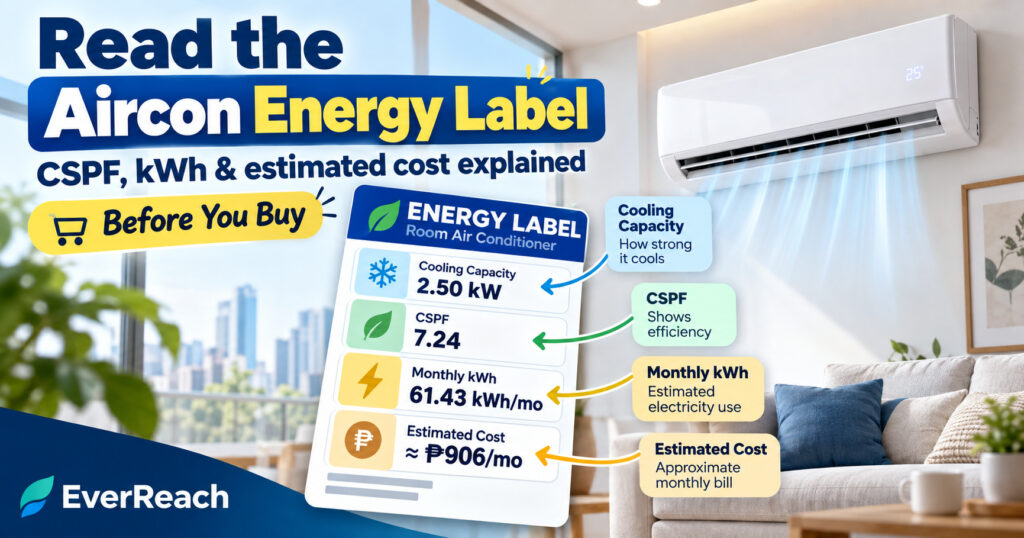
The Department of Energy requires covered air conditioners to carry an energy guide under the Philippine Energy Labeling Program. DOE’s technical rules define the Cooling Seasonal Performance Factor (CSPF) as the seasonal cooling load divided by seasonal energy consumption.
In plain language:
CSPF tells you how much seasonal cooling the air conditioner delivers for the electricity it uses.
For comparable units, a higher CSPF means better energy efficiency.
Read the label in this order
| Check | What it tells you | How to use it |
|---|---|---|
| 1. Exact model number | Identifies the specific indoor/outdoor unit combination | Match it exactly with the DOE database and seller listing |
| 2. Cooling capacity | How much cooling the unit can provide | Compare units of similar capacity first |
| 3. CSPF | Seasonal energy efficiency | Higher is generally better when capacity is comparable |
| 4. Star rating | DOE efficiency class based on CSPF | Useful shortcut, but still read the actual CSPF |
| 5. Power input | Rated electrical input under specified conditions | Useful context, but not the same as constant real-world draw |
| 6. Monthly energy consumption | DOE-listed estimate/test-derived monthly kWh figure | Multiply by your ₱/kWh rate for a budgeting estimate |
| 7. Product type | Fixed-speed or variable-speed | Confirms whether DOE classifies the unit as fixed or variable capacity |
| 8. Refrigerant and GWP | Refrigerant type and climate-impact metric | Important environmental information, but separate from electricity efficiency |
1. Start with cooling capacity — not horsepower
Cooling capacity is the amount of heat the air conditioner can remove from the room. DOE labels and approved-product records express it in kilowatts (kW) of cooling capacity.
This is not the same thing as the electrical watts consumed by the unit.
A unit with 2.50kW of cooling capacity does not mean it consumes 2,500 watts of electricity. Cooling capacity and electrical power input measure different things.
Retail “horsepower” is useful as a familiar capacity class, but when comparing efficiency, use the actual DOE cooling-capacity figure.
This also prevents a common mistake: comparing the CSPF of a small air conditioner with a much larger one and declaring one “better” without first checking whether they are designed for the same cooling load.
2. CSPF is the number to understand
DOE defines CSPF as:
Cooling Seasonal Total Load ÷ Cooling Seasonal Energy Consumption
You do not need to calculate this yourself. The DOE label and PELP database provide the rated CSPF.
When two air conditioners have comparable cooling capacity:
That makes CSPF more useful than simply asking whether a unit is “inverter.” Two inverter models can have significantly different CSPF values.
3. What do the stars mean?
DOE’s air-conditioner rules classify energy efficiency by CSPF and represent the class with stars. In the DOE technical framework, more stars correspond to higher CSPF ranges.
That means the stars are a useful visual shortcut—but they should not replace the actual number.
If two units both qualify for a high efficiency class, one may still have a noticeably higher CSPF than the other.
EverReach recommendation: use the stars to narrow the field, then compare the actual CSPF.
4. Power input is useful — but easy to misread
The DOE database also lists Power Input (Watts).
For a fixed-speed air conditioner, the compressor generally operates in a more on/off manner. A variable-speed or inverter unit can change compressor output as the cooling demand changes.
That is why you should not calculate an inverter air conditioner’s monthly bill by assuming its rated power input is drawn at full power for every minute it is switched on.
The rated power figure is still useful for comparison and electrical planning, but seasonal consumption is better represented by CSPF and the DOE energy-consumption data.
5. The monthly kWh figure can be turned into pesos
DOE’s approved-product pages show a Monthly Energy Consumption (kWh) figure and a sample electricity-cost formula.
To turn monthly kWh into an estimated peso cost:
Monthly electricity cost = monthly kWh × your electricity rate
For example, Meralco’s overall residential rate for a typical household in September 2026 is ₱14.7424/kWh. Your own utility and bill may differ, so use your actual rate whenever possible.
A real DOE example: same cooling capacity, very different efficiency
Historical records in DOE’s approved-product database illustrate why CSPF matters. The two variable-speed units below both have a listed cooling capacity of 2.50kW, but their energy figures are very different.
| DOE-listed example | Example A | Example B |
|---|---|---|
| Cooling capacity | 2.50kW | 2.50kW |
| CSPF | 7.24 | 4.49 |
| Power input | 455W | 733W |
| DOE monthly energy figure | 61.43kWh | 98.96kWh |
| Illustrative cost at ₱14.7424/kWh | ₱905.63/month | ₱1,458.91/month |
Using those label figures, the illustrative difference is about ₱553.28 per month, or roughly ₱6,639 per year.
That does not prove Example A is automatically the better purchase. You would still need to compare:
- current purchase price;
- installation cost;
- warranty;
- service support;
- features;
- noise;
- actual room suitability; and
- current product availability.
But it shows why two air conditioners that look similar on the shelf can have very different ownership costs.
6. Fixed-speed vs variable-speed: check the DOE product type
DOE’s database identifies air conditioners as categories such as:
- AC Fixed (ACF) — fixed-speed / fixed-capacity; and
- AC Variable (ACV) — variable-speed / variable-capacity.
This is useful because it gives you an independent specification beyond marketplace marketing.
DOE product examples also show different sample utilization factors in its monthly-consumption calculation: variable-speed examples commonly display an F value of 0.50, while fixed-speed examples can display 0.80.
You do not need to reproduce that factor yourself when the DOE database already provides the monthly energy figure. For your own home, actual energy use will still depend on temperature setting, weather, insulation, room heat load and usage behavior.
7. R32 vs R410A: useful information, but don’t confuse GWP with electricity efficiency
The PELP database also identifies the refrigerant and its Global Warming Potential (GWP).
DOE-listed examples show R32 with a GWP of 675 and R410A with a GWP of 2,088.
That matters environmentally, especially if refrigerant is released.
But GWP is not an air conditioner’s electricity-efficiency score. Use CSPF for energy efficiency and GWP for refrigerant climate impact.
8. Verify the exact model in DOE’s database
Do not search only by brand or series name.
Air conditioners that look nearly identical can have different:
- cooling capacities;
- indoor/outdoor model combinations;
- CSPF values;
- refrigerants;
- power inputs; and
- energy-label control numbers.
Copy the exact model number from the seller listing or nameplate and look for the same code in the DOE Philippine Energy Labeling Program database.
Also check the Energy Label Issued dates shown in the DOE record. A very old record is useful for historical comparison but may not establish the current certification status of a model being sold today.
The label cannot tell you whether the aircon is correctly sized for your room
Efficiency and sizing are different questions.
An extremely efficient air conditioner can still perform poorly if it is badly matched to the room.
Cooling load depends on more than floor area:
- ceiling height;
- sun exposure;
- roof and wall construction;
- windows and glass area;
- insulation;
- number of occupants;
- computers and other heat-producing equipment; and
- how often doors are opened.
Use room-size rules only as a starting estimate. For difficult rooms, large spaces or expensive installations, a proper cooling-load assessment is worth more than guessing from horsepower alone.
Do not automatically buy the highest-CSPF model
Efficiency matters, but it is only one part of ownership cost.
Imagine two correctly sized units:
- Unit A costs ₱8,000 more but saves only ₱100 per month;
- Unit B costs less upfront but has a lower CSPF.
The ₱8,000 premium would take about 80 months to recover from ₱100 monthly savings—before considering repairs, financing or replacement.
But if the more efficient aircon saves ₱500 per month, the same ₱8,000 premium would be recovered in about 16 months.
That is why EverReach prefers an ownership-cost comparison, not “buy the most stars at any price.”
A simple aircon buying sequence
- Determine the cooling capacity you actually need.
- Shortlist units in roughly the same capacity class.
- Verify their exact model numbers in PELP.
- Compare CSPF and star rating.
- Compare DOE-listed monthly kWh.
- Convert kWh to pesos using your electricity rate.
- Compare purchase price and calculate payback.
- Check warranty, service network and installation requirements.
- Check noise and features that matter to you.
- Then choose—not before.
Use your own electricity rate
If the DOE page gives you a monthly kWh figure, calculating the budget impact is easy:
Monthly cost = DOE monthly kWh × your electricity rate
If you want to estimate other appliances—or compare aircon figures using your own rate—use EverReach’s Appliance Electricity Cost Calculator.
Remember that real aircon consumption can vary significantly from a label-based estimate because compressor load changes with weather, temperature setting, insulation and room conditions.
Common mistakes when reading an aircon label
Comparing CSPF across very different cooling capacities
Start by matching the capacity needed for the room. Efficiency comparisons are most meaningful among suitable units with similar cooling output.
Assuming inverter automatically means highly efficient
Variable-speed technology creates the opportunity for better part-load efficiency, but CSPF tells you how the specific model performs in the DOE framework.
Choosing only by horsepower
Horsepower is a familiar retail shorthand. The DOE cooling-capacity number is better for precise comparison.
Treating rated watts as continuous consumption
Especially for inverter units, the compressor does not necessarily remain at rated input for the entire operating period.
Ignoring purchase-price premium
A lower monthly bill is valuable, but calculate how long it takes to recover the extra upfront cost.
Assuming the marketplace model name is enough
Always check the exact indoor/outdoor model code against the DOE record.
Frequently Asked Questions
What is CSPF in an air conditioner?
CSPF means Cooling Seasonal Performance Factor. DOE defines it as seasonal cooling load divided by seasonal energy consumption. For air conditioners with comparable cooling capacity, a higher CSPF generally means better seasonal energy efficiency.
Is higher CSPF better?
Yes, when you are comparing units suited to the same cooling requirement. Do not choose an undersized air conditioner simply because it has an attractive CSPF.
Is a 5-star aircon always cheaper to own?
Not necessarily. A more efficient model can use less electricity but may cost more upfront. Compare the purchase-price difference with estimated monthly savings and expected ownership period.
Is inverter the same as 5-star?
No. “Inverter” describes variable-speed compressor control. Star rating reflects the DOE efficiency class based on CSPF. Different inverter models can have different CSPF values.
What does cooling capacity in kW mean?
It describes how much cooling the air conditioner can provide. It is not the same as electrical power input. Use cooling capacity to match the unit to the room and to compare similarly sized models.
Can I use the DOE monthly kWh as my exact electric bill?
No. It is a standardized comparison/budgeting figure, not a guarantee. Actual energy use varies with usage hours, temperature setting, weather, insulation, heat load, maintenance and other conditions.
Where can I check if an aircon model is DOE-listed?
Search the Department of Energy’s Philippine Energy Labeling Program website using the exact model number.
The EverReach Bottom Line
The Philippine aircon energy label is much more useful when you stop treating it as a star sticker and start reading the numbers behind it.
For a smart comparison:
- match cooling capacity;
- compare CSPF;
- check monthly kWh;
- convert kWh into your own electricity cost; and
- compare the savings with the purchase-price premium.
The highest-rated model is not automatically the best purchase at any price. The cheapest model is not automatically the cheapest to own.
Choose the right capacity first. Then let CSPF and ownership cost help you choose the better aircon.
Sources and Further Reading
- Department of Energy: Philippine Energy Labeling Program — searchable approved-product database and energy-consumption information.
- DOE Particular Product Requirements for Air Conditioners — CSPF definition, energy-efficiency classification and energy-label requirements.
- DOE product record: 2.50kW variable-speed example with CSPF 7.24.
- DOE product record: 2.50kW variable-speed example with CSPF 4.49.
- DOE product record: fixed-speed air-conditioner example.
- Meralco: Lower Rates this September 2026 — current Meralco residential-rate reference used for the illustrative peso comparison.
- EverReach: How Much Does This Appliance Cost to Run? Use Your Own Electricity Rate.
Editorial disclosure: EverReach may earn a commission from qualifying purchases made through affiliate links, at no extra cost to you. Affiliate relationships do not determine our conclusions. Product records used in the examples are educational comparisons from the DOE database and are not EverReach product endorsements.
About the Author
Noah Evermore writes research-based buying guides for EverReach, focusing on technology, compatibility, practical value and the Philippine consumer context.