Research reviewed: September 17, 2026. Electricity rates change by month, utility, location and consumption level. The examples below use a recent Meralco residential rate only to demonstrate the math. For your own budget, use your actual electricity rate or recent bill.
Two appliances can have very different price tags—but the cheaper one to buy is not always the cheaper one to own.
A fan might cost only a few pesos a day to run. An air conditioner can add hundreds or thousands of pesos a month. A refrigerator runs all day, but its compressor cycles on and off. An induction cooker may be rated at 1,500W or 2,000W, yet you might use it for only a short time.
So instead of asking:
“How much electricity does this appliance use?”
ask a more useful question:
“How many kilowatt-hours will I actually use, and what does one kilowatt-hour cost me?”
The basic formula:
Monthly cost = (Watts ÷ 1,000) × Hours used per day × Days used per month × Your electricity rate per kWh
The simple formula
Electric utilities charge for energy, usually measured in kilowatt-hours (kWh).
If an appliance uses 500 watts for four hours a day:
500W ÷ 1,000 = 0.5kW
0.5kW × 4 hours = 2kWh per day
Over 30 days:
2kWh × 30 = 60kWh per month
If your effective electricity rate were ₱14.7424/kWh:
60kWh × ₱14.7424 = about ₱884.54 per month
That ₱14.7424/kWh figure is the overall September 2026 Meralco rate reported for a typical residential household. It is only an example. Your actual rate may be different, especially if you are outside the Meralco service area or your bill contains different consumption tiers and adjustments.
Watts and kWh are not the same thing
This distinction causes a lot of confusion.
- Watts (W) tell you how much power an appliance is drawing at a moment in time.
- Kilowatt-hours (kWh) tell you how much energy it used over time.
A 1,000W appliance running for one hour uses:
1,000W ÷ 1,000 × 1 hour = 1kWh
A 100W appliance would have to run for ten hours to use the same 1kWh.
That is why a high-wattage kettle can still cost relatively little if you use it for only a few minutes, while a lower-wattage appliance running all day can add up.
How to find your own electricity rate
The best number to use is not a random rate you found in an old Facebook post or article. Use a recent bill.
Method 1: Use your utility’s published residential rate
This is useful for a quick estimate. Meralco, electric cooperatives and other distribution utilities publish or report current rates, but those rates change.
For example, Meralco’s overall residential rate for a typical household was reported at ₱14.7424/kWh for September 2026, down slightly from August.
Method 2: Estimate your effective all-in rate from your bill
For household budgeting, a practical estimate is:
Effective rate = total electricity bill ÷ total kWh consumed
Example:
If your bill is ₱3,150 for 210kWh:
₱3,150 ÷ 210 = ₱15.00/kWh
You can then use ₱15/kWh for rough appliance-cost estimates.
This is an average household budgeting rate, not a precise marginal tariff calculation. One-time refunds, arrears, credits, taxes, minimum charges or tiered distribution charges can make the effective rate slightly different from the cost of adding exactly one more kWh.
For comparing appliances, however, using your recent effective rate is usually much more useful than relying on an old generic ₱10/kWh assumption.
Quick examples at ₱14.7424/kWh
The examples below show the arithmetic only. They are not claims about the actual consumption of every fan, router, laptop or television. Your appliance may use more or less.
| Illustrative load | Monthly energy | Approx. monthly cost |
|---|---|---|
| 10W router, 24 hours/day | 7.2kWh | ₱106.15 |
| 45W fan, 8 hours/day | 10.8kWh | ₱159.22 |
| 60W laptop, 8 hours/day | 14.4kWh | ₱212.29 |
| 100W TV, 4 hours/day | 12kWh | ₱176.91 |
| 1,500W kettle, 10 minutes/day | 7.5kWh | ₱110.57 |
| 1,000W cooking appliance, 1 hour/day | 30kWh | ₱442.27 |
Why the wattage label can mislead you
The number printed on an appliance is often a rated input or maximum operating value. It does not necessarily mean the appliance consumes that amount continuously.
This is especially important for:
- refrigerators;
- air conditioners;
- inverter appliances;
- rice cookers that switch to warm mode;
- laptops and chargers;
- washing machines; and
- devices with thermostats, compressors or variable-speed motors.
A refrigerator may have a rated input of 100W, for example, but the compressor does not normally run at full rated power every minute of the day.
DOE’s Philippine Energy Labeling Program reflects this difference. Approved refrigerator listings can show both a rated power input in watts and a separate tested energy consumption in kWh per 24 hours. For estimating monthly refrigerator cost, the tested kWh figure is usually more useful than multiplying the rated wattage by 24 hours.
Use the Philippine Energy Label when available
For covered appliances, the Department of Energy’s Philippine Energy Labeling Program (PELP) can give you more useful consumption information than the basic product nameplate.
Depending on the appliance category, the label or DOE database may show values such as:
- monthly energy consumption in kWh;
- kWh per 24 hours;
- kWh per wash cycle;
- power input in watts;
- energy-efficiency factor;
- cooling seasonal performance factor; or
- star rating.
If an appliance already gives you a tested monthly kWh figure, the calculation becomes very easy:
Monthly cost = tested monthly kWh × your electricity rate
For example, if a refrigerator’s verified energy consumption is 24kWh/month and your rate is ₱15/kWh:
24 × ₱15 = ₱360 per month
Air conditioners need a different mindset
Air conditioners are one of the easiest appliances to estimate badly.
If an inverter air conditioner is rated at 1,250W, multiplying 1.25kW by nine hours every night assumes it consumes the full rated input continuously for all nine hours.
That is often unrealistic.
Once the room approaches the thermostat set point, an inverter compressor can reduce output. Actual consumption changes with:
- room size;
- outside temperature;
- sun exposure;
- insulation;
- number of people;
- door openings;
- temperature setting;
- humidity;
- filter cleanliness; and
- how oversized or undersized the unit is.
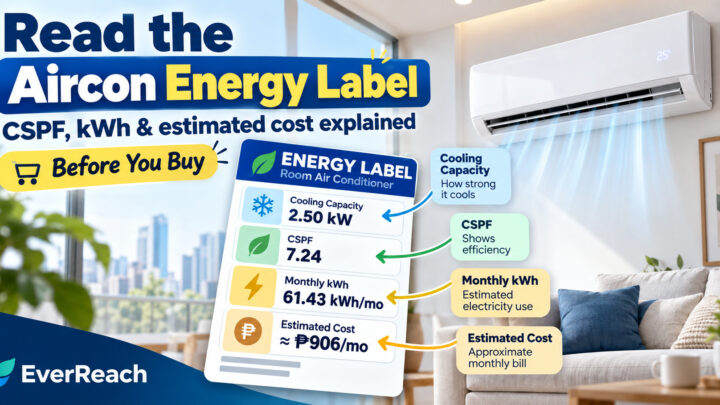
DOE’s PELP air-conditioner data therefore includes tested monthly energy-consumption figures and performance metrics such as CSPF, rather than asking consumers to infer everything from rated watts alone.
Meralco’s own Appliance Calculator also warns that estimates for compressor-based appliances such as refrigerators and air conditioners can differ from actual use, particularly during hotter months when compressors work harder.
The best method: measure the appliance
If you want a more realistic number, measure actual energy use.
For a suitable plug-in appliance, an energy-monitoring meter can record:
- instantaneous watts;
- kWh accumulated over several hours or days;
- voltage;
- current; and
- sometimes power factor.
Instead of guessing that your fan uses exactly 45W for eight hours, you can measure what it actually uses at your preferred speed.
For appliances that cycle, measure for long enough to capture normal operation. A five-minute refrigerator reading tells you very little; a 24-hour or multi-day kWh measurement is much more useful.
Do not use a small plug-in meter on appliances whose current or startup load exceeds the meter’s rating. High-power or hardwired equipment should be measured using equipment and methods appropriate to the circuit.
Standby power: small watts, long hours
A device drawing only 3W in standby sounds trivial.
But over 24 hours a day for 30 days:
3W ÷ 1,000 × 24 × 30 = 2.16kWh
At ₱14.7424/kWh, that is about ₱31.84 per month.
One device is not dramatic. Ten similar always-on loads would be roughly ₱318 per month at the same example rate.
That does not mean you should unplug every device in the house. Some equipment needs to remain powered, and repeated switching can be inconvenient or inappropriate. The point is simply that low wattage × many hours × many devices can become noticeable.
Daily cost, monthly cost and yearly cost
Looking only at daily cost can make an inefficient appliance feel cheaper than it really is.
If an appliance costs ₱30 per day to operate:
- 30 days ≈ ₱900;
- 365 days ≈ ₱10,950.
For appliances you will own for years, annual running cost can matter more than a small difference in purchase price.
A better way to compare two appliances
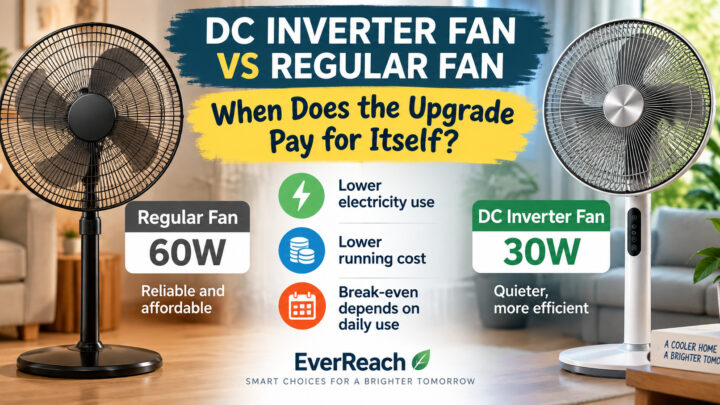
Suppose Appliance A costs ₱3,000 less than Appliance B.
But Appliance A uses 20kWh more electricity each month.
At ₱15/kWh:
20kWh × ₱15 = ₱300 extra per month
At that difference, the ₱3,000 purchase-price savings would be consumed by higher electricity cost in about:
₱3,000 ÷ ₱300 = 10 months
After that, the apparently cheaper appliance becomes more expensive to own.
This is why EverReach prefers comparing purchase price + realistic running cost + expected ownership period, not purchase price alone.
Free Appliance Cost Calculator
Enter your own appliance wattage, usage time and electricity rate. This calculator is intended for fixed-load estimates. For refrigerators, inverter air conditioners and other cycling or variable-load appliances, measured kWh or energy-label consumption data is usually more realistic.
Monthly kWh = (W ÷ 1,000) × hours/day × days/month
Monthly cost = monthly kWh × ₱/kWh
Tip: If you already know the appliance’s tested monthly energy consumption in kWh from a Philippine Energy Label or a power meter, multiply that kWh figure directly by your electricity rate instead of using rated watts.
Common mistakes when estimating appliance cost
Using an old ₱/kWh figure
Electricity rates change. A calculation based on ₱10/kWh can be badly misleading if your actual effective rate is closer to ₱15/kWh.
Assuming rated watts are consumed continuously
This is particularly inaccurate for compressors, thermostatic appliances and variable-speed/inverter devices.
Ignoring usage time
A 2,000W appliance used for five minutes can consume less monthly energy than a 40W device running around the clock.
Comparing appliance wattage without comparing the job performed
A higher-wattage appliance may finish the job much faster. Cooking cost depends on total energy used, not wattage alone.
Treating every month as identical
Air-conditioner use rises during hot months. Refrigerator compressors may work harder in warmer conditions. School schedules, work-from-home days and holidays can all change household consumption.
Ignoring standby and always-on devices
Small loads can become meaningful when multiplied by 24 hours, 30 days and several devices.
What EverReach would use for different appliance types
| Appliance type | Best starting data |
|---|---|
| Simple fan or lamp | Measured watts or rated watts × actual hours |
| Router / networking equipment | Measured real watts × 24-hour use |
| TV / desktop monitor | Measured watts at your normal brightness and usage |
| Refrigerator | DOE/energy-label kWh per day or measured 24-hour/multi-day kWh |
| Air conditioner | DOE energy-label monthly kWh, CSPF and/or measured energy over representative use |
| Washing machine | kWh per cycle × cycles per month |
| Rice cooker | Measured cooking + keep-warm energy per use |
| Induction cooker / kettle | Measured or rated watts × actual cooking minutes |
Frequently Asked Questions
How do I calculate appliance electricity cost in the Philippines?
For a fixed-load appliance, use:
(Watts ÷ 1,000) × hours used × days used × your ₱/kWh rate
Use your latest utility rate or effective rate from your own bill rather than an old generic price.
How much is one kWh in the Philippines?
There is no single nationwide residential price. Rates vary by distribution utility, location and billing month. Meralco's overall rate for a typical residential household was reported at ₱14.7424/kWh in September 2026, but customers elsewhere should use their own utility rate.
Does a 1,000W appliance use 1kWh?
Only if it draws 1,000W continuously for one hour. If it runs for 30 minutes, that would be 0.5kWh. If it cycles on and off, actual energy use may be lower.
Can I calculate refrigerator cost from the wattage sticker?
You can make a rough worst-case calculation, but it is usually not the best estimate because the compressor cycles. A DOE energy-label kWh figure or a multi-day energy measurement is more useful.
How do I estimate inverter aircon electricity cost?
Do not assume the rated wattage is consumed continuously. Use the Philippine Energy Label's tested energy-consumption information where available, or measure actual kWh over representative use. Room temperature, set point, weather and insulation strongly affect real consumption.
Is a higher-wattage appliance always more expensive to run?
No. Running cost depends on total kWh used. A high-power appliance used briefly may consume less energy than a low-power appliance running for many hours.
The EverReach Bottom Line
Do not judge appliance running cost from wattage alone.
You need three things:
- how much power or energy the appliance actually uses;
- how long or how often you use it; and
- your own electricity rate per kWh.
For simple fixed loads, the basic watts × hours formula works well.
For refrigerators, air conditioners and other cycling or inverter appliances, use tested energy-label data or actual kWh measurements when possible.
And when comparing two products, look beyond the purchase price. A more efficient appliance can recover a higher upfront cost through lower electricity bills over time.
Use your rate. Use your hours. Calculate your cost.
Sources and Further Reading
- Meralco: Manage Your Monthly Consumption / Appliance Calculator — explains Meralco's appliance-cost calculator and notes that cooling-appliance consumption can vary with conditions.
- Meralco: Lower Rates this September 2026 — current Meralco rate advisory used for the article's illustrative September 2026 rate.
- Philippine News Agency: Meralco power rates drop anew in September — reports the September 2026 overall residential rate of ₱14.7424/kWh for a typical household.
- Department of Energy: Philippine Energy Labeling Program — approved appliance energy-label data and electricity-consumption information.
- Department of Energy: Philippine Energy Labeling Program Guidelines.
Editorial disclosure: EverReach may earn a commission from qualifying purchases made through affiliate links, at no extra cost to you. Affiliate relationships do not determine our conclusions. Electricity-cost examples are estimates and are not guarantees of your actual bill.
About the Author
Noah Evermore writes research-based buying guides for EverReach, focusing on technology, compatibility, practical value and the Philippine consumer context.